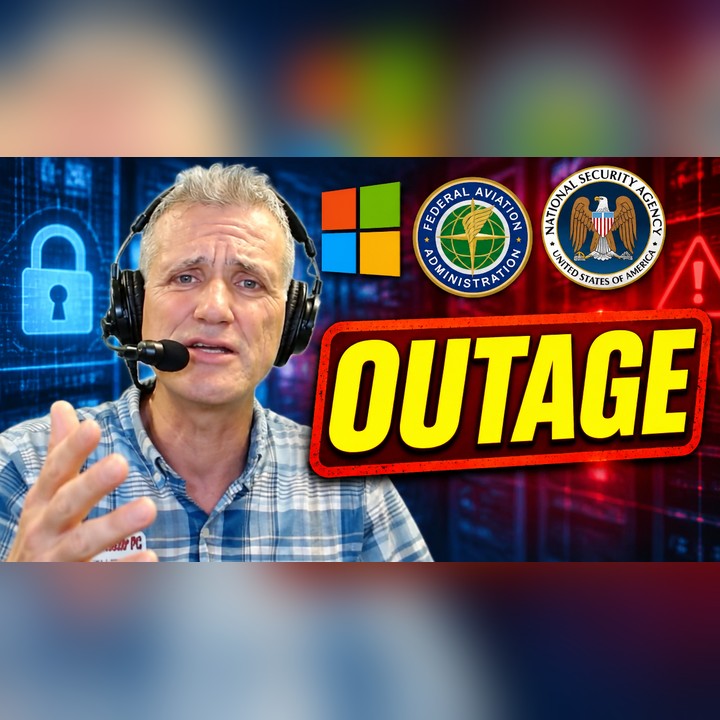
In the space of six days, Microsoft 365 email went dark worldwide, the FAA halted every departing flight in America, Chase customers were locked out of online banking, and on Tuesday, November 17, Apple iCloud, Gmail, Marriott, and even the NSA's classified internal network all reported problems. One U.S. senator said that if it's all a coincidence, it's the greatest coincidence in the history of the world. So is America under cyber attack, or did technology just have a really bad week?
In this episode of A Faster PC Live Technical Support, Bryan Longworth walks through what each company and agency says caused its outage, the one confirmed cyber attack of the week (which almost nobody noticed), a new warning from Google about AI-driven attacks, and five things every Florida business owner and home user should do the next time email or banking goes down.
Microsoft 365 Outage: A Bug Hiding in a July Update
On Thursday, November 12, Microsoft 365 went down worldwide for nearly 24 hours, and many people could not get into their email at all.
Microsoft says the cause was a bug hiding inside an update it rolled out back in July. The update ran fine for more than three months. Then a surge of extra traffic hit, and in less than two hours more than 80% of Microsoft's network gateway servers stopped responding. In plain English, the main doors people use to get into Microsoft 365 stopped answering.
Microsoft said plainly that this was not a cyber attack and not AI. It isn't the first time an update has caused trouble, either. Back in the spring, we covered an Outlook outage that Microsoft also traced to a change on its end.
There's one more detail worth remembering: Microsoft's own threat team said scammers launched a phishing campaign that took advantage of the outage.
FAA Nationwide Ground Stop: A New Router in Arkansas
On Friday, November 13, the FAA issued a nationwide ground stop. Thousands of flights were disrupted, and the stop lasted more than four hours.
Officials say the contractor, L3Harris, installed a new router at a radio transmission site in Arkansas that day. That router flooded the network with connection signals and interfered with controllers' ability to talk to planes. The FAA has since paused new router installations nationwide.
Transportation Secretary Sean Duffy says the problem has been recreated, but there is no clarity on the root cause yet. He asked the FBI to help examine the hardware, and Bloomberg reported the FBI does not believe a cyber attack caused it.
Why Investigators Are Looking Closely at Juniper
CNN reported the new routers are made by Juniper, and Juniper routers have been targeted by Chinese hackers before. Earlier this year, we told you about a critical Juniper router flaw that could hand an attacker full control. There is no evidence this router was compromised, but it is one reason the FBI is looking at it carefully.
Chase Banking Outage: One Bank's Bug
On Monday, Chase customers reported problems with online banking, the mobile app, and transfers. Wells Fargo, Bank of America, and Zelle users reported trouble as well.
Chase blamed a software bug in its own on-premises hardware and said there is no evidence it was cyber-related. Chase also said other banks only saw slowness on transactions where Chase was involved. In other words, one bank's bug made it look like the whole banking system was down.
Apple iCloud and the NSA Network: Updates and Maintenance
On Tuesday, Apple's status page showed iCloud sign-in as slow or unavailable for all users. That afternoon, Apple said an internal update caused the outages and ruled out a cyber attack. By around 5 p.m. Eastern, Apple showed everything operating normally.
The outage that got the most attention was the NSA's classified internal network. A U.S. official told Fox News the system had temporary degradation during scheduled routine maintenance, and a White House spokesperson said there is no evidence it was a cyber attack.
Notice the pattern: an update, new equipment, another update, and maintenance.
Lawmakers in Both Parties Want Answers
Republican Senator Josh Hawley wants a briefing for the full Senate and questioned how a router in Arkansas could affect flights nationwide. House Democratic Leader Hakeem Jeffries said it is unclear whether the outages are all infrastructure-related or some malignant activity, and called for briefings for both parties.
As of Tuesday, no company or agency has said any of these outages was a cyber attack.
The Real Cyber Attack Nobody Noticed: Optimizely
While everyone was watching the outages, a real cyber attack happened on Monday, and nothing went down.
It involved Optimizely, a company big websites use to test their pages. Those websites load a small piece of Optimizely's code every time you visit. Optimizely says attackers exploited a flaw in its account signup process and slipped malicious code into customers' projects. Security researcher Scott Helme found it running for 178 organizations, including Zoom, CNN, Fox News, the BBC, Salesforce, and Equifax.
What the Malicious Code Did
- Swapped cryptocurrency wallet addresses so payments went to the attackers
- Skimmed payment card information
- Loaded attack tools aimed at iPhones and iPads running older software
Optimizely says it has fixed the flaw, removed the malicious code, and notified affected customers.
Why Real Attacks Are Quiet
The outages were loud. The attack was silent, and that is what a real attack usually looks like. Criminals do not want your systems down. They want them up and running, quietly working for them.
This is called a supply chain attack. You trust the website. The website trusts the vendor. When the vendor gets hit, you get hit. We saw the same thing a few weeks ago, when WordPress plugins shipped malware straight from the vendor's own website.
Google's Warning: "The Era of Autonomous Attacks Has Arrived"
On Monday, Google's Threat Intelligence Group declared that the era of autonomous attacks has arrived. Google found an AI framework that compares software before and after a security update, figures out which hole was patched, and builds an attack for it without a human directing each step.
Google does not connect this to the outages. But think about the pattern: updates can break things, and at the same time, criminals' AI is reading those same updates to go after anyone who has not installed them yet.
ARTEX and the FBI Flash Warning
Google is not alone. ARTEX is an AI hacking tool tied to attacks on South Korean banks. Police in Seoul arrested a former security tester who used it, and the founder of WorkOS said it was used to breach his company. According to CNN, the FBI says ARTEX was used in the ConnectWise cloud backup attack we covered a few weeks ago.
On the same Friday as the FAA ground stop, the FBI issued a flash warning that criminals around the world are using ARTEX, in some cases going from first contact to full access in under three hours.
So skipping updates is not the answer. The answer is to patch quickly and patch carefully. If you need a refresher on what's in this month's updates, see our November 2026 Patch Tuesday guide.
Glitch or Hack? Two Clues to Tell the Difference
One researcher who tracks up to 12 network outages a day told Wired that about 1 in 1,000 turns out to be a hacker. Here are two clues that help you tell the difference.
Clue 1: Who Takes the Blame?
Microsoft, Chase, and Apple all said, in effect, "This one is on us." Real attackers, like ransomware gangs, usually make themselves known. Nobody has claimed credit for any of these outages.
Clue 2: How Long Does It Last?
As one expert put it, a rollback takes minutes or hours. Ransomware takes days or even weeks.
The Verdict So Far
Based on everything reported as of November 17, the outages look like glitches: bugs, updates, and new equipment. But experts told CNN that fully ruling out hackers takes time, because some state-backed hackers disguise themselves as normal network activity. The FAA investigation is still open, and we will update you if anything changes. The confirmed hack this week was Optimizely, and most people never noticed it.
5 Things to Do the Next Time Your Email or Bank Goes Down
- Check the official status page yourself. Type the company's web address in. Do not click a link in an email or text that says there is an outage. Remember, scammers used Microsoft's outage as bait.
- Do not reset your password "just in case" from a link someone sent you.
- Watch your statements. If you entered a card on a big-name website on Monday, watch your statement. If you use crypto, double-check the wallet address before you hit send.
- Keep your iPhone, iPad, and every other device updated. If a device is too old to update, it's time to replace it.
- Have a Plan B. Keep a printed phone list, offline copies of key files, and a backup way to reach your team and customers. Learn more about planning for business interruptions.
Frequently Asked Questions About This Week's Outages: Hack or Glitch?
Was the Microsoft 365 outage a cyber attack?
No. Microsoft says the November 12 outage was caused by a bug hiding inside an update it rolled out in July. When a surge of extra traffic hit, more than 80% of its network gateway servers stopped responding. Microsoft said plainly it was not a cyber attack and not AI.
What caused the FAA nationwide ground stop?
Officials say contractor L3Harris installed a new router at a radio transmission site in Arkansas, and that router flooded the network with connection signals that interfered with controllers' ability to talk to planes. Bloomberg reported the FBI does not believe a cyber attack caused it, but the investigation is still open and the FAA has paused new router installations nationwide.
How can I tell if an outage is a glitch or a hack?
Look at two clues. First, who takes the blame: companies like Microsoft, Chase, and Apple said the problem was on their end, while real attackers such as ransomware gangs usually make themselves known. Second, how long it lasts: a rollback takes minutes or hours, while ransomware recovery takes days or even weeks.
What is a supply chain attack?
A supply chain attack happens when criminals break into a vendor that other companies trust. This week, attackers slipped malicious code into Optimizely customer projects, so the code ran on websites belonging to organizations like Zoom, CNN, and Equifax. You trust the website, the website trusts the vendor, and when the vendor gets hit, you get hit.
Should I stop installing updates if updates cause outages?
No. Google's Threat Intelligence Group found AI tools that compare software before and after a security update and build an attack for the hole that was patched, and the FBI warned that criminals using the ARTEX tool can go from first contact to full access in under three hours. Skipping updates leaves you exposed. The answer is to patch quickly and patch carefully.
What should I do the next time my email or bank goes down?
Check the official status page by typing the web address in yourself, and don't click outage links in emails or texts, because scammers used Microsoft's outage as phishing bait. Don't reset your password from a link someone sent you. Keep your devices updated, and have a Plan B with a printed phone list, offline copies of key files, and a backup way to reach your team and customers.
Who can help my Treasure Coast, Space Coast, or South Florida business prepare for outages and cyber attacks?
A Faster PC is a managed services provider serving Florida's Treasure Coast, Space Coast, and South Florida. We keep your systems updated, watch for threats, and help you build a Plan B before you ever need it. Call 772-878-5978 or visit https://www.AFasterPC.com to get started.
About A Faster PC
A Faster PC is the leading managed services provider (MSP) serving Florida's Treasure Coast, Space Coast, and South Florida. A Faster PC provides responsive IT support, advanced cybersecurity solutions, cloud backup, disaster recovery, breach remediation, patch management, computer repair, and technical support for accounting offices, attorneys' offices, medical offices, dental offices, professional offices, small- to medium-sized businesses, non-profits, churches, home office users, and individuals throughout the regions. We help our clients cut costs in their Internet, TV, and telephone bills and in business operations.
Every week at 10:07 AM EST, A Faster PC hosts A Faster PC Live Technical Support, which is a live Radio Show that is livestreamed to YouTube and Facebook and is available as a podcast. Visit our Live Technical Support page for various ways to schedule a technical support session and for various ways to listen to and watch A Faster PC Live Technical Support.
A Faster PC services the following counties and cities: St. Lucie County including: Port St. Lucie, Fort Pierce, St. Lucie West, Tradition, St. Lucie Village; Martin County including: Stuart, Jensen Beach, Jupiter Island, Ocean Breeze Park, and Sewall's Point; Indian River County: including Vero Beach, Sebastian, Fellsmere, Indian River Shores; Palm Beach County including: Jupiter, Jupiter Inlet Colony, Juno Beach, Tequesta, Palm Beach Gardens, North Palm Beach, Palm Beach Shores, Riviera Beach, West Palm Beach, Wellington, Royal Palm Beach, Greenacres, Lake Worth Beach, Lantana, Boynton Beach, Ocean Ridge, Briny Breezes, Gulf Stream, Delray Beach, Highland Beach, and Boca Raton; Broward County including: Fort Lauderdale, Hollywood, Pompano Beach, Coral Springs, Pembroke Pines, Miramar, Davie, Plantation, Sunrise, Deerfield Beach, Lauderhill, Weston, Tamarac, Coconut Creek, Margate, Lauderdale Lakes, Oakland Park, Hallandale Beach, Cooper City, Wilton Manors, Lighthouse Point, Parkland, Lauderdale-by-the-Sea, Sea Ranch Lakes, Lazy Lake, Hillsboro Beach, Southwest Ranches, North Lauderdale, Dania Beach; Miami-Dade County including: Miami, Miami Beach, Hialeah, Miami Gardens, Coral Gables, Homestead, Doral, North Miami, Aventura, Kendall, Cutler Bay, Sunny Isles Beach, Key Biscayne, Pinecrest, Surfside, Bal Harbour, North Miami Beach, Palmetto Bay, Miami Springs, Opa-locka, Miami Lakes, Florida City, South Miami, Sweetwater, West Miami, Bay Harbor Islands, Biscayne Park, El Portal, Golden Beach, Hialeah Gardens, Indian Creek, Medley, North Bay Village, and Virginia Gardens; and Okeechobee County including: Okeechobee, Taylor Creek, Cypress Quarters, Fort Drum, and Basinger.
Watch the full video here: Are the Outages Hacking or Tech Glitches? The Warning You Need to Hear.
Protect Your Florida Business with A Faster PC
This week proved two things: technology can fail all by itself, and when real attackers strike, you often don't see it coming.
If you own a business on Florida's Treasure Coast, Space Coast, or in South Florida, A Faster PC can help. As a managed services provider (MSP), we keep your systems updated, watch for threats, and make sure you have a Plan B before you ever need it.
Call A Faster PC today at 772-878-5978, schedule a discovery call, and download our free cybersecurity report.