This week's cybersecurity news is a wake-up call, and it doesn't matter how big or small your business is. A nation-state hacking group used a fake job posting to breach defense companies. Microsoft SharePoint suffered its fifth exploited vulnerability of the summer. And in one of the stranger stories this year, a plane full of cybersecurity experts got hacked while they were 30,000 feet in the air. If professionals with that level of security training can get caught off guard, it's worth asking how protected your own business really is.
A Fake Job Posting Just Breached Defense Companies in Four Countries
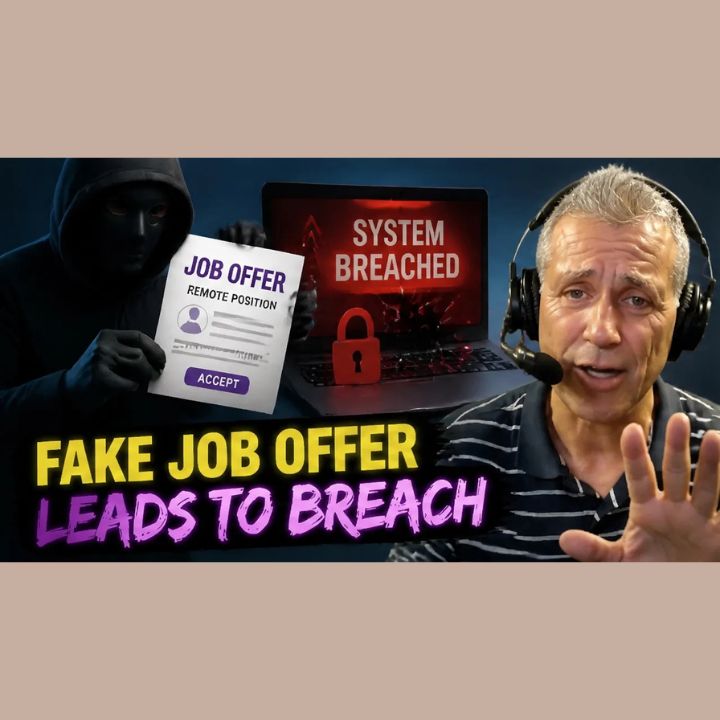
North Korea's Lazarus Group has been running a long-term campaign posing as recruiters on sites like LinkedIn, in some cases using fake Lockheed Martin job postings to appear legitimate. When a victim responds, the group sends a malicious file that quietly hands over full control of the machine. This is the fourth time since 2022 that Lazarus has targeted the same Windows weak spot, exploiting it before Microsoft could patch it.
What This Means for Your Business
If your employees ever receive unsolicited job offers or recruiting messages that ask them to open a file, especially anything referencing defense or government work, treat it as suspicious until proven otherwise. One careless click from one employee is all it takes.
Microsoft SharePoint's Fifth Flaw of the Summer
SharePoint has been a recurring headache all summer, and this week added two more problems. A newly discovered flaw lets an attacker bypass login entirely and impersonate any user, including an administrator, without needing a password — real attacks began within a day of proof-of-concept code being published. Separately, the July SharePoint flaw tied to an overseas government breach is now being actively used by ransomware gangs.
Confirm Your Patches Are Actually Installed
If your business runs SharePoint on its own servers rather than in Microsoft's cloud, confirm both your July and August patches are installed. Patching once does not mean you're covered for the rest of the summer — attackers are watching these flaws, and they move fast.
SonicWall Devices Are Now Under Active Ransomware Attack
Malware discovered on SonicWall security appliances a few weeks ago initially looked like a targeted, sophisticated attack. Federal cybersecurity officials now say ransomware gangs are actively using those same SonicWall flaws to break into networks and lock up business data. If your business runs one of these devices, confirming your patches is no longer optional homework — it's this week's priority. Ransomware doesn't care how big your company is; it just needs one unlocked door.
Three Newly Patched Vulnerabilities Are Already Being Exploited
This month's Patch Tuesday fixed a large batch of security flaws across Microsoft and other vendors, but three of those fixes are already being attacked just days later: a severe SAP Commerce Cloud flaw now being targeted in real attacks, a critical Adobe Commerce vulnerability being used to hijack customer accounts on online stores, and a Cisco antivirus flaw with public exploit code now circulating. Patching this week and being safe this week are not automatically the same thing. Confirm that your patches actually took effect.
A Trojanized WireGuard VPN Is Targeting IT Professionals
Russian military intelligence has been caught distributing a fake, tampered-with version of WireGuard VPN, a legitimate tool many companies use for secure remote connections. The fake version looks and works like the real thing but has a hidden backdoor built in. This matters even if you're not an IT professional yourself, because a single compromised IT worker's machine can become a launching point into every business they manage. If your business or IT provider uses WireGuard, download it only from the official source — never from a third-party site or a search ad.
A Few More Stories Worth Watching
- Steam hardware data breach.
The company behind the Steam gaming platform notified customers who purchased hardware like the Steam Deck or Steam Controller of a data breach. Watch for phishing emails that mention your specific order — that personal detail is exactly what makes a scam email convincing. - A power plant breach shows why unmonitored connections are dangerous.
Hackers broke into a small energy plant last year through an unmonitored private cellular connection used for remote equipment monitoring, and the breach went unnoticed for over a year. It's the third critical infrastructure story of this kind in recent weeks — attackers keep finding the side doors nobody's watching. The systems your business isn't actively monitoring are usually where trouble sneaks in. - The good guys are fighting back.
Ukrainian authorities shut down 94 fraudulent call centers in a single coordinated effort, seizing millions in cash used to scam victims — a reminder that even large-scale scam operations aren't untouchable.
Even Cybersecurity Experts Got Hacked on a Plane
Delta Airlines is investigating a Wi-Fi attack that knocked passengers off the internet on a flight carrying attendees returning from Def Con, one of the largest hacking conferences in the world. Nobody has confirmed who was behind it, but the takeaway applies to everyone: in-flight Wi-Fi is a shared, largely unprotected network. If you wouldn't do banking on random coffee shop Wi-Fi, don't do it on a plane either — and if security experts can get caught off guard, none of us should assume we're immune.
Protect Your Business Before an Attacker Finds the Gap
If any of these stories made you wonder how protected your business really is, that's exactly what A Faster PC does every day. We provide managed IT and cybersecurity services for accountants' offices, attorneys' offices, medical and dental offices, educational facilities, nonprofits, churches, and small to mid-sized businesses across the **Treasure Coast, Space Coast, and South Florida** — plus clients across the country and around the world.
Call us at 772-878-5978 or visit AFasterPC.com to grab our free cybersecurity report and see where your biggest risks are. While you're at it, download our Free Cybersecurity Risk Report today.
Frequently Asked Questions
Q: What is the biggest cybersecurity threat facing small businesses right now?
A: One of the most active threats right now is phishing through fake job postings, where attackers pose as recruiters to trick employees into opening malicious files. Combined with newly discovered flaws in tools many businesses already use, like Microsoft SharePoint and SonicWall devices, it only takes one careless click to open the door to a full network compromise.
Q: What is the Microsoft SharePoint vulnerability everyone is talking about?
A: This summer, SharePoint has had five separate security flaws exploited, including one that lets an attacker bypass login credentials entirely and impersonate any user, even an administrator, without a password. If your business runs SharePoint on its own servers rather than in Microsoft's cloud, it's critical to confirm your July and August patches are fully installed.
Q: How do fake job postings lead to a cybersecurity breach?
A: Attackers pose as recruiters on sites like LinkedIn, sometimes using fake postings from well-known companies to appear legitimate. When a victim responds and opens the attached file, it quietly installs malware that gives the attacker full control of the computer. Treat any unsolicited job or recruiting message that asks you to open a file as suspicious until proven otherwise.
Q: Is it safe to use public Wi-Fi, like on an airplane?
A: Not for anything sensitive. In-flight Wi-Fi is a shared, largely unprotected network, and a recent Delta Airlines flight carrying cybersecurity professionals from a major hacking conference was hit with a Wi-Fi attack mid-flight. If you wouldn't do online banking on random coffee shop Wi-Fi, don't do it on a plane either.
Q: What should I do if my business uses SonicWall devices or WireGuard VPN?
A: Confirm your SonicWall patches from recent weeks are actually installed, since ransomware gangs are now actively exploiting those flaws. If your business or IT provider uses WireGuard VPN, only download it from the official source — attackers have been distributing a fake, backdoored version through third-party sites and search ads.
Q: How can Treasure Coast, Space Coast, and South Florida businesses protect themselves from these threats?
A: Working with a local managed IT provider like A Faster PC means your patches, monitoring, and employee security training are handled proactively instead of after a breach. A Faster PC serves accountants, attorneys, medical and dental offices, nonprofits, schools, and small businesses throughout the Treasure Coast, Space Coast, and South Florida.
Q: How often are new cybersecurity vulnerabilities being discovered?
A: Constantly, and attackers are moving faster than ever. Three vulnerabilities patched during this month's Patch Tuesday, in SAP Commerce Cloud, Adobe Commerce, and Cisco antivirus software, were already being actively exploited within days of the fix being released. Applying a patch once isn't enough; businesses need to confirm patches actually took effect and stay current every month.
Q: What does A Faster PC do to help protect my business?
A: A Faster PC provides managed IT and cybersecurity services, including patch management, network monitoring, and a free cybersecurity risk report, so you can see where your biggest vulnerabilities are before an attacker finds them. Call 772-878-5978 or visit AFasterPC.com to get started.
Watch the full video here: Why Even The Experts Are Getting Hacked.
About A Faster PC
A Faster PC the leading managed services provider (MSP) serving Florida's Treasure Coast, Space Coast, and South Florida. A Faster PC provides responsive IT support, advanced cybersecurity solutions, cloud backup, disaster recovery, breach remediation, patch management, computer repair, and technical support for accounting offices, attorneys' offices, medical offices, dental offices, professional offices, small- to medium-sized businesses, non-profits, churches, home office users, and individuals throughout the regions. We help our clients cut costs in their Internet, TV, and telephone bills and in business operations.
Every week at 10:07 AM EST, A Faster PC hosts A Faster PC Live Technical Support, which is a live Radio Show that is livestreamed to YouTube and Facebook and is available as a podcast. Visit our Live Technical Support page for various ways to schedule a technical support session and for various ways to listen to and watch A Faster PC Live Technical Support.
A Faster PC services the following counties and cities: St. Lucie County including: Port St. Lucie, Fort Pierce, St. Lucie West, Tradition, St. Lucie Village; Martin County including: Stuart, Jensen Beach, Jupiter Island, Ocean Breeze Park, and Sewall's Point; Indian River County: including Vero Beach, Sebastian, Fellsmere, Indian River Shores; Palm Beach County including: Jupiter, Jupiter Inlet Colony, Juno Beach, Tequesta, Palm Beach Gardens, North Palm Beach, Palm Beach Shores, Riviera Beach, West Palm Beach, Wellington, Royal Palm Beach, Greenacres, Lake Worth Beach, Lantana, Boynton Beach, Ocean Ridge, Briny Breezes, Gulf Stream, Delray Beach, Highland Beach, and Boca Raton; Broward County including: Fort Lauderdale, Hollywood, Pompano Beach, Coral Springs, Pembroke Pines, Miramar, Davie, Plantation, Sunrise, Deerfield Beach, Lauderhill, Weston, Tamarac, Coconut Creek, Margate, Lauderdale Lakes, Oakland Park, Hallandale Beach, Cooper City, Wilton Manors, Lighthouse Point, Parkland, Lauderdale-by-the-Sea, Sea Ranch Lakes, Lazy Lake, Hillsboro Beach, Southwest Ranches, North Lauderdale, Dania Beach; Miami-Dade County including: Miami, Miami Beach, Hialeah, Miami Gardens, Coral Gables, Homestead, Doral, North Miami, Aventura, Kendall, Cutler Bay, Sunny Isles Beach, Key Biscayne, Pinecrest, Surfside, Bal Harbour, North Miami Beach, Palmetto Bay, Miami Springs, Opa-locka, Miami Lakes, Florida City, South Miami, Sweetwater, West Miami, Bay Harbor Islands, Biscayne Park, El Portal, Golden Beach, Hialeah Gardens, Indian Creek, Medley, North Bay Village, and Virginia Gardens; and Okeechobee County including: Okeechobee, Taylor Creek, Cypress Quarters, Fort Drum, and Basinger.