
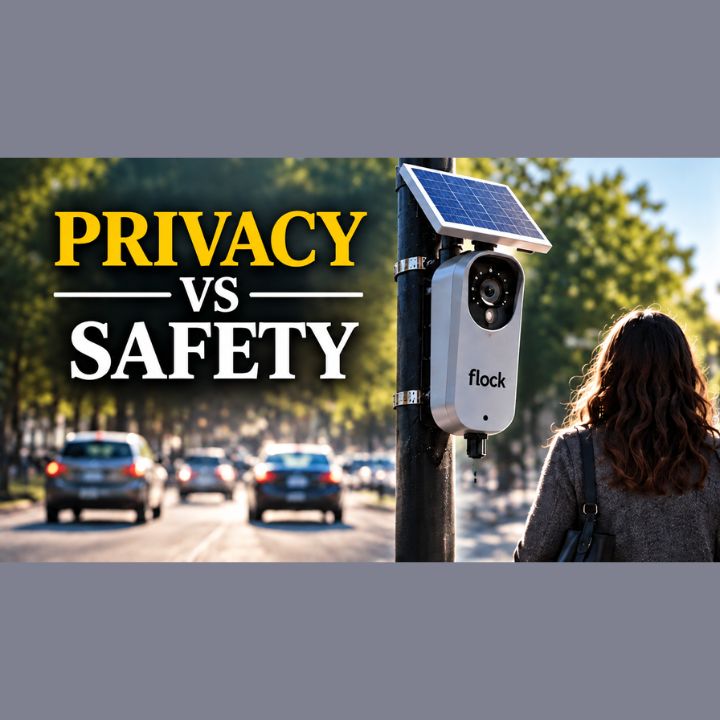
You've probably driven past one today without noticing it: a small gray box on a pole with a little solar panel on top, sitting at an intersection you drive through all the time. It's a Flock camera, and it logs your car every time you go by. Within a few days of each other, the Florida Department of Transportation and the St. Lucie County Commission both moved to restrict these cameras, and local law enforcement agencies each responded differently.
Here's a plain-English look at what Flock cameras actually record, how large the network has become, the strongest arguments on both sides, and what just happened here on Florida's Treasure Coast.
What Is a Flock Camera?
Flock Safety is the company. The technology is called an automated license plate reader, or ALPR. Flock says its cameras do not use facial recognition and do not identify the driver. They identify the car.
What a Flock Camera Records
Each time a vehicle passes, the camera logs:
- The license plate number and state
- The car's color and make
- Distinguishing details such as a roof rack, a bumper sticker, or a dent, which Flock calls a "vehicle fingerprint"
- The date, time, and exact location
A single record might read: plate ABC 123, silver Honda, seen at this intersection at 8:42 a.m.
On its own, that doesn't sound alarming. But for a business owner, here's a useful comparison: imagine someone wrote down every customer who visited your shop, every day, whether they bought anything or not.
How Big Is the Flock Camera Network?
Flock says its network now covers more than 120,000 cameras across 49 states and more than 6,000 cities and towns. Independent volunteers who mapped the cameras block by block have physically confirmed roughly 80% of that total. Even by the more careful count, that likely means 100,000 or more cameras already logging traffic in real neighborhoods.
One camera taking one photo isn't a big deal. Connect more than 120,000 of them to the same searchable database, and it stops being a camera. It becomes a network, one that can show where a car has been, over and over, across an entire city.
That raises the central question in this debate: to find one bad guy, do we have to photograph everybody?
Why Police Departments Want Flock Cameras
There's a real public safety case here, and it deserves a fair hearing.
Picture a car used in an armed robbery where officers have only a partial plate number. In the past, that description went out over the radio, and everyone hoped an officer would happen to spot the car in traffic.
With Flock, when that plate passes any camera in the network, it's automatically checked against databases such as the National Crime Information Center and missing child databases, instantly, without anyone needing to be on the right corner at the right moment. Flock says the system helped close more than a million investigations last year and helped locate nearly 10,000 missing people.
If your child were missing, a system that spots the car in nine seconds instead of nine hours would be hard to argue with. That is the strongest argument for this technology.
The Privacy Concerns About License Plate Readers
Privacy groups such as the ACLU aren't arguing that an officer can't look at your license plate on a public road. That has always been legal. Their objection is to the collection and storage of millions of innocent people's movements, when police only ever search a tiny fraction of that data.
Are Search Logs Enough to Prevent Misuse?
Flock's answer is that access is controlled. Every search requires a stated investigative reason, and every search is logged with a username and timestamp so supervisors can audit it.
From a cybersecurity standpoint, both sides are telling the truth. Flock does log searches. The ACLU is also right that logging a search after the fact doesn't stop someone from lying about why they ran it, and there have already been real cases of officers misusing this system to track people such as ex-partners.
That's a principle we apply every day in [business cybersecurity protection] → https://www.afasterpc.com/advanced-cybersecurity/ for clients across the Treasure Coast, Space Coast, and South Florida: audit logs are good, but they are not the same as prevention.
How Long Does Flock Keep Your Data?
Flock's default retention period was 30 days. After documented misuse cases, Flock announced it is cutting the default to seven days, with the change becoming mandatory for law enforcement customers starting January 1.
There's a catch. A feature called evidence mode lets police keep data tied to an active case indefinitely. Critics say that, depending on how loosely it's used, very little data may actually get deleted.
Put it in business terms: if you told your customers you delete credit card numbers after seven days, except whenever you decide something is evidence, they would want to read the fine print.
What Florida Just Did About Flock Cameras
This is no longer just a national story. It's happening on our roads.
FDOT Revokes License Plate Reader Permits on State Highways
On Monday, August 31, the Florida Department of Transportation revoked every permit for license plate readers on state highways statewide, citing concerning reports of misuse, data privacy concerns, and surveillance schemes. Agencies were given 30 days to remove the equipment. The order applies only to state highways.
St. Lucie County Commission Votes 3-2 to Restrict Flock Cameras
The next night, September 1, St. Lucie County commissioners went further. By a 3-2 vote, they directed the county to:
- Stop issuing new permits for Flock cameras and other plate readers on county roads
- Review every existing permit
- Issue 30-day removal notices
- Build a full inventory of every device
Commissioners Larry Leet, Erin Lowry, and James Clasby voted yes. Chair Jamie Fowler and Commissioner Cathy Townsend voted no, saying they wanted more public input and wanted to hear from the sheriff first.
How Treasure Coast Law Enforcement Responded
- St. Lucie County Sheriff Richard Del Toro said he will comply on state highways and tighten his office's own rules, limiting searches to forcible felonies and missing persons cases, requiring undersheriff approval, and restricting access to lieutenants and above. He did not remove cameras from county roads.
- Port St. Lucie Police removed seven cameras in state right-of-way and paused the rest of their Flock and Axon systems, except for immediate threats to life with the chief's sign-off.
- Martin County Sheriff John Budensiek is keeping his other cameras running while pushing for statewide rules instead of local bans.
In about 72 hours, four Florida agencies gave four different answers. Meanwhile, a Reuters/Ipsos poll that closed the same week found that only 38% of Americans support these cameras in their communities, while 47% oppose them.
Privacy vs. Safety: There's No Simple Verdict
Both of these things are real. Flock cameras help police find stolen cars and missing people. They also create a searchable record of where ordinary cars have been, whether or not those cars are connected to a crime.
The harder questions are about who gets to search that record:
- Can your local department share your car's history with another department three states away?
- Can federal agencies get access without you knowing?
- What happens when the safeguards fail?
We'll dig into those questions in upcoming episodes of this series, starting with what a Flock search actually shows on screen and why the difference between identifying a car and identifying a person matters more than you might think. Catch every episode on our weekly live technical support show.
Protect Your Business Data With A Faster PC
Whether it's a camera network collecting data or a hacker trying to get into your business systems, protecting your information matters. A Faster PC is a [managed IT services provider for Treasure Coast businesses] → https://www.afasterpc.com/ serving Florida's Treasure Coast, Space Coast, and South Florida, along with clients across the country and around the world. We help businesses protect their data against the real threats that show up in the inbox, not just on a pole beside the highway.
Want a second set of eyes on how your business protects its data? Call A Faster PC at 772-878-5978, schedule a FREE discovery call, or contact our team. While you're on AFasterPC.com, download our free cybersecurity report.
Frequently Asked Questions
Q: What is a Flock camera?
A: A Flock camera is an automated license plate reader (ALPR) made by Flock Safety, usually a small gray box on a pole with a solar panel on top. It records passing vehicles' plate numbers and state, color, make, and details like bumper stickers or dents, along with the date, time, and location. Flock says the cameras identify the car, not the driver.
Q: Do Flock cameras use facial recognition?
A: According to Flock Safety, no. The company says its cameras do not do facial recognition and do not identify the driver. Instead, they capture what Flock calls a "vehicle fingerprint," which combines the license plate with features like the car's color, make, roof rack, stickers, or dents.
Q: How many Flock cameras are there in the United States?
A: Flock says its network covers more than 120,000 cameras across 49 states and over 6,000 cities and towns. Independent volunteers mapping the cameras block by block have physically confirmed roughly 80% of that total, which still suggests 100,000 or more cameras logging traffic in real neighborhoods.
Q: How long does Flock keep license plate data?
A: Flock's default retention was 30 days. After documented misuse cases, Flock announced it is cutting the default to seven days, mandatory for law enforcement customers starting January 1. A feature called evidence mode lets police keep data tied to an active case indefinitely, and critics say loose use of it could mean very little actually gets deleted.
Q: Why do police use Flock license plate readers?
A: When a plate passes any Flock camera, it's automatically checked against databases such as the National Crime Information Center and missing child databases, so officers don't have to rely on someone spotting a car in traffic. Flock says the system helped close more than a million investigations last year and helped locate nearly 10,000 missing people.
Q: Did Florida ban Flock cameras?
A: Not on every road. On August 31, the Florida Department of Transportation revoked every permit for license plate readers on state highways and gave agencies 30 days to remove the equipment. That order covers only state highways, so counties and cities are making their own decisions about local roads.
Q: What did St. Lucie County decide about Flock cameras?
A: On September 1, St. Lucie County commissioners voted 3-2 to stop issuing new permits for Flock cameras and other plate readers on county roads, review existing permits, issue 30-day removal notices, and inventory every device. Across the Treasure Coast, responses varied: Port St. Lucie Police removed seven cameras and paused the rest, while the St. Lucie and Martin County sheriffs took different approaches.
Q: Are audit logs enough to prevent misuse of license plate data?
A: Logs help, but they aren't prevention. Flock requires a stated reason for every search and logs each one with a username and timestamp, yet that doesn't stop someone from lying about why they ran a search, and officers have misused the system to track ex-partners. A Faster PC applies the same lesson when protecting business data for clients on the Treasure Coast, Space Coast, and South Florida.
Watch the full video here: Flock Cameras Are Everywhere—Here Is What You Should Know.
About A Faster PC
A Faster PC the leading managed services provider (MSP) serving Florida's Treasure Coast, Space Coast, and South Florida. A Faster PC provides responsive IT support, advanced cybersecurity solutions, cloud backup, disaster recovery, breach remediation, patch management, computer repair, and technical support for accounting offices, attorneys' offices, medical offices, dental offices, professional offices, small- to medium-sized businesses, non-profits, churches, home office users, and individuals throughout the regions. We help our clients cut costs in their Internet, TV, and telephone bills and in business operations.
Every week at 10:07 AM EST, A Faster PC hosts A Faster PC Live Technical Support, which is a live Radio Show that is livestreamed to YouTube and Facebook and is available as a podcast. Visit our Live Technical Support page for various ways to schedule a technical support session and for various ways to listen to and watch A Faster PC Live Technical Support.
A Faster PC services the following counties and cities: St. Lucie County including: Port St. Lucie, Fort Pierce, St. Lucie West, Tradition, St. Lucie Village; Martin County including: Stuart, Jensen Beach, Jupiter Island, Ocean Breeze Park, and Sewall's Point; Indian River County: including Vero Beach, Sebastian, Fellsmere, Indian River Shores; Palm Beach County including: Jupiter, Jupiter Inlet Colony, Juno Beach, Tequesta, Palm Beach Gardens, North Palm Beach, Palm Beach Shores, Riviera Beach, West Palm Beach, Wellington, Royal Palm Beach, Greenacres, Lake Worth Beach, Lantana, Boynton Beach, Ocean Ridge, Briny Breezes, Gulf Stream, Delray Beach, Highland Beach, and Boca Raton; Broward County including: Fort Lauderdale, Hollywood, Pompano Beach, Coral Springs, Pembroke Pines, Miramar, Davie, Plantation, Sunrise, Deerfield Beach, Lauderhill, Weston, Tamarac, Coconut Creek, Margate, Lauderdale Lakes, Oakland Park, Hallandale Beach, Cooper City, Wilton Manors, Lighthouse Point, Parkland, Lauderdale-by-the-Sea, Sea Ranch Lakes, Lazy Lake, Hillsboro Beach, Southwest Ranches, North Lauderdale, Dania Beach; Miami-Dade County including: Miami, Miami Beach, Hialeah, Miami Gardens, Coral Gables, Homestead, Doral, North Miami, Aventura, Kendall, Cutler Bay, Sunny Isles Beach, Key Biscayne, Pinecrest, Surfside, Bal Harbour, North Miami Beach, Palmetto Bay, Miami Springs, Opa-locka, Miami Lakes, Florida City, South Miami, Sweetwater, West Miami, Bay Harbor Islands, Biscayne Park, El Portal, Golden Beach, Hialeah Gardens, Indian Creek, Medley, North Bay Village, and Virginia Gardens; and Okeechobee County including: Okeechobee, Taylor Creek, Cypress Quarters, Fort Drum, and Basinger.